

In advance of the UN Summit of the Future, Earth4All has released a new report detailing two possible futures for Sub-Saharan Africa this century. The report, “SDGs for All: Africa,” uses Earth4All’s state-of-the-art system dynamics model to chart possible pathways for SDG implementation in the region. Written in collaboration with notable African sustainability experts, the report emphasises the scale and urgency of economic transformation needed to meet the Sustainable Development Goals (SDGs) in the region.
SDGs for All: Africa
In the best-case scenario, called the “Giant Leap,” Sub-Saharan Africa could see poverty drop from 500 million to 25 million people, hunger nearly eradicated, and universal access to education, clean water, and sustainable electricity. On the other hand, the “Too Little Too Late” scenario paints a grim picture where poverty rises to 900 million, hunger still affects 180 million, and over a billion people lack clean water. The Too Little Too Late scenario is based on existing policies in the region. These two scenarios highlight the critical importance of action this decade to drive five extraordinary turnarounds in the areas of poverty, inequality, empowerment, food, and energy.
Key highlights from the modelling for Sub-Saharan Africa include:
- Poverty reduction: Under the Giant Leap scenario, poverty decreases dramatically from 500 million to 25 million people by 2100, compared to a rise to 900 million under the Too Little Too Late scenario.
- Hunger Eradication: Hunger is nearly eradicated in the Giant Leap, with undernourishment dropping to 20 million, in stark contrast to 180 million under the Too Little Too Late scenario.
- Education Access: The average schooling years increase to 13, up from 8 years under the Too Little Too Late scenario.
- Water Access: Universal water access is achieved by 2070, significantly improving from over one billion without access in the Too Little Too Late scenario.
- Electricity Access: Sustainable electricity access reaches over 95% by 2050, compared to 75% still lacking access under the Too Little Too Late scenario.
- Climate Mitigation: Carbon emissions are reach acceptable levels by 2040 as opposed to dangerous levels that push global temperatures even higher.
- Economic Growth: Decent work and economic growth see significant boosts, with unemployment falling to 50 million by 2100, compared to 150 million in the Too Little Too Late scenario. Workers’ disposable income and GDP per capita also see substantial increases, doubling in comparison to the Too Little Too Late scenario. And inequality is greatly reduced with labour’s share of GDP reaching 60% by 2040, thereby making Africa one of the most equal regions in the world
The new research from Earth4All, an international team of economists and scientists, shows the policy levers needed to ensure that the SDGs are met in Sub-Saharan Africa by 2100. The report ‘SDGs for All: Africa’ equips policymakers with practical solutions designed to accelerate SDG implementation and to respond to the planetary emergency. It concludes that policymakers can step up the implementation of the SDGs by 2030 and beyond and achieve wellbeing for all. But this is only possible by enacting five ‘extraordinary turnarounds’ that break with current trends.
“The challenge for Sub-Saharan Africa this century is that economic transformation must now take place in the shadow of a climate emergency. This is a breakthrough or breakdown moment for the continent. It teeters on the brink of two vastly different futures: one of transformative progress and one of deepening despair. As we approach the UN Summit of the Future this September, the time for bold, decisive action is now—to ensure a ‘Giant Leap’ towards a future where poverty and hunger are eradicated, and every individual has access to education, clean water, and sustainable energy. Our choices today will shape the destiny of millions. We must act, and we must act decisively.” Said Jane Kabubo-Mariara, Executive Director of the Partnership for Economic Policy and member of the Earth4All Transformational Economics Commission.
“The UN Summit of the Future is the next port of call to leverage the global support for action on the SDG’s and ensure governments and the Bretton Woods institutions?heighten the ambition needed on eradicating poverty and inequality within the planetary boundaries. This summit presents a crucial opportunity for world leaders to commit to the transformative solutions and partnerships needed.”?said Sandrine Dixson-Declève, co-president of The Club of Rome and Executive Chair of Earth4All. “Our findings demonstrate that systemic change, focusing on reducing inequality and poverty, is not just beneficial but necessary for sustainable development and climate resilience in Africa and the rest of the world.”
The report, supported by the UN University Centre for Policy Research (UNU-CPR) and the UN Futures Lab, serves as a critical resource ahead of the upcoming Summit of the Future, urging global leaders, policymakers, and stakeholders to act decisively. It builds on Earth4All’s system dynamics modelling of the SDGs, which culminated in a global report published last year: SDGs for All.
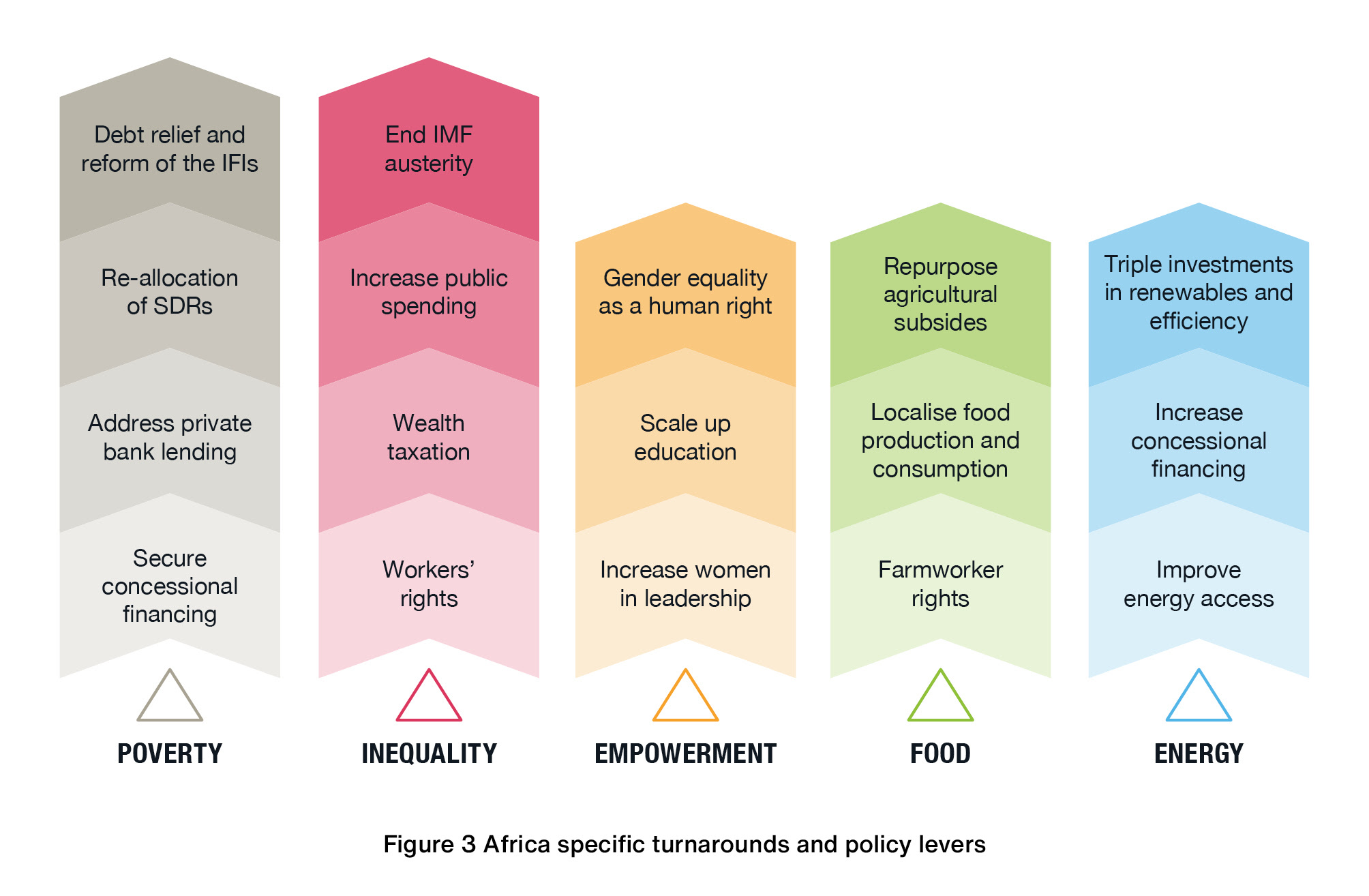
To achieve the pace and scale of change required for meaningful SDG progress by 2050, the report identifies several urgent policy levers which need to be implemented simultaneously.
Earth4All and the UN University Centre for Policy Research (UNU-CPR), supported by the UN Futures Lab, will be holding a special event to launch the report on Monday September 23 | 13:00 to 15:00 at Bahá’í International Community’s United Nations Office, New York. For more info contact [email protected]
About Earth4All
Earth4All is a vibrant collective of leading economic thinkers, scientists and advocates, convened by The Club of Rome, the BI Norwegian Business School, the Potsdam Institute for Climate Impact Research and the Stockholm Resilience Centre
Earth4All builds on the legacies of The Limits to Growth and the Planetary Boundaries frameworks. Earth for All: A Survival Guide for Humanity, was published in September 2022 and presents the results of a major two-year research collaboration.
About the SDGs for All: Africa report
The SDGs for All: Africa report applies the unique Earth4All system dynamics model, future scenarios and recommended pathways for change, which were developed for the 2022 book Earth for All: A Survival Guide for Humanity.
The two scenarios are:
- ‘Too Little Too Late’ – a decision-making as usual approach resulting in deepening wealth inequality, growing social tensions and limited efforts to address climate and ecological risks. As a result, global temperature increases to 2.5°C by 2100 putting the stability of the earth system at risk. Wellbeing continues to dramatically decline globally, and it takes until 2100 to eradicate extreme poverty.
- ‘The Giant Leap’ – an alternative, achievable path costing 2-4% GDP per annum that empowers society to make ambitious decisions by implementing five extraordinary turnarounds simultaneously across poverty, inequality, empowerment, food and energy. As a result, temperatures would stabilise below 2°C, material consumption is reduced, extreme poverty is eradicated by 2050, social tensions fall dramatically, inequality is reduced, and wellbeing rises exponentially. If policymakers around the world embrace this ‘Giant Leap’, huge improvements for people and planet are possible.
See more breaking stories here.
More about Irish Tech News
Irish Tech News are Ireland’s No. 1 Online Tech Publication and often Ireland’s No.1 Tech Podcast too.
You can find hundreds of fantastic previous episodes and subscribe using whatever platform you like via our Anchor.fm page here: https://anchor.fm/irish-tech-news
If you’d like to be featured in an upcoming Podcast email us at [email protected] now to discuss.
Irish Tech News have a range of services available to help promote your business. Why not drop us a line at [email protected] now to find out more about how we can help you reach our audience.
You can also find and follow us on Twitter, LinkedIn, Facebook, Instagram, TikTok and Snapchat.