
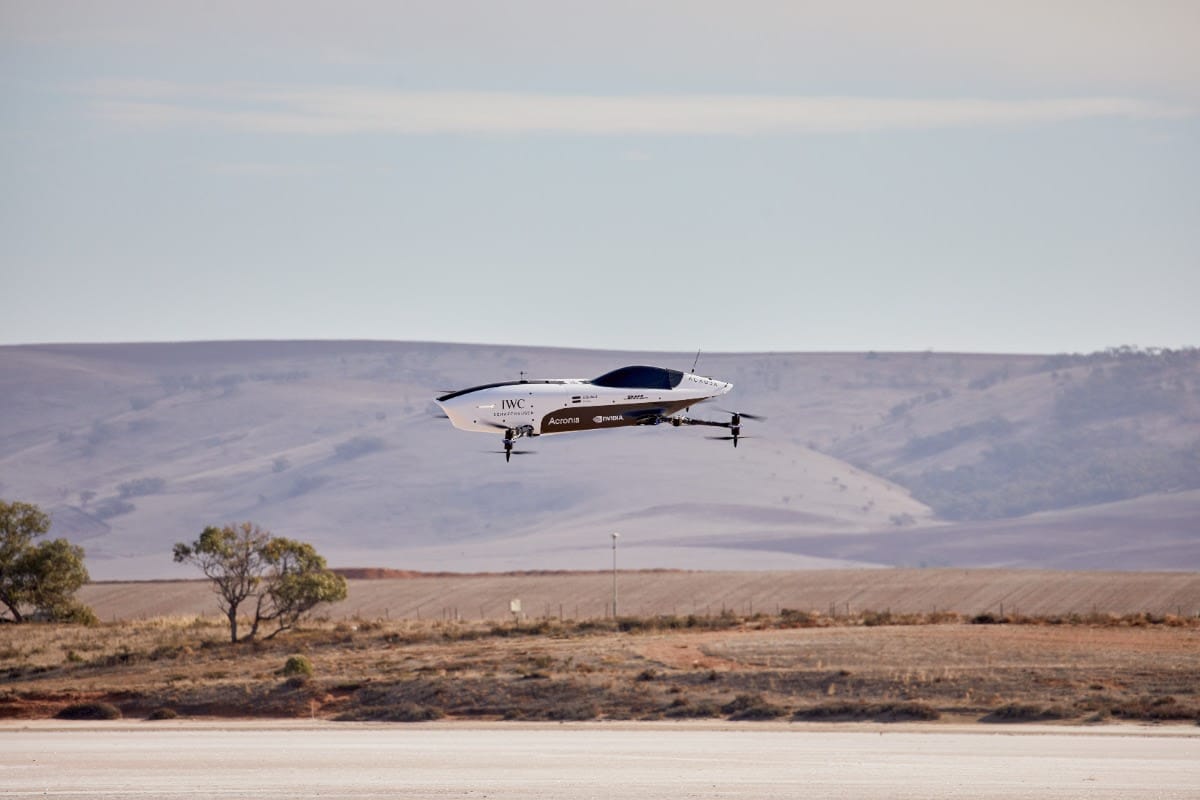
The first flight of the electric racing car, the remotely piloted Alauda Airspeeder Mk3 was announced in mid-June of this year.
The flight took place in an undisclosed test location of South Australia in the desert, surveyed by AI.
Matthew Pearson the founder of Airspeed and Alauda Aeronautics stated in 2019 that his ambition was to create the world’s first racing series for electric flying cars.
The Team
The Alauda Team apart of Alauda Aeronautics worked with the regulator throughout development to ensure compliance to all required procedures while developing robust safety protocols.
Pearson gathered a team of technical experts, engineers, and designers from F1, performance automotive, civil, and military aviation backgrounds to create an entirely new classification of advanced aircraft.
The successful flights recorded are a green flag for un-crewed electric flying car Grand Prix’s which will take place in 2021, in three international locations.
The Airspeeder’s first racing series, EXA, will have up to four teams with two remote pilots per team competing in three individual events across the globe.
The races will witness pilots from aviation, motorsport, and eSports backgrounds to remotely pilot the world’s only racing electric vertical take-off and landing (eVTOL) craft.
The pilots will control their Speeders in a simulator environment that mimics the dynamics and ergonomics of the Mk3 cockpit environment.
Navigating through an electronically governed, augmented reality enabled sky-tracks with finger-tip commands sent instantly to the physical Speeder as it plots a series of courses, the pilots will race ‘blade-to-blade over locations inaccessible to traditional motorsport.
Physical telerobotic avatars named ‘The Aviators’ designed to represent the frame of human pilots are also within the cockpit environment of the Mk3.
They will provide engineers with critical data and information on the effects of high-speed racing, rapid turning, acceleration and deceleration on the human frame.
Aiding the advancement to human-piloted races in 2022.
Alauda Airspeeder Safety
Airspeeder employs a systems-based approach to safety meaning no single operational failure can lead to loss of the primary function of the vehicle, which is controlled flight.
During flights all systems are monitored on the ground through a telemetry system, enabling the ground crew to become aware of issues.
Prioritising safety is also inherent to the architecture of the vehicle.
In addition to this, every Airspeeder race includes rapid pit stops and engineers have developed an innovative ‘slide and lock’ system for the swift removal and replacement of batteries when on the ground.

Competition between in-house pit crews has driven the pitstop time down to just 20 seconds.
Power delivery profiles for the Speeder can be changed by ground crews to respond to the different requirements of the electronically governed sky-tracks that Airspeeder pilots will follow.
Ground crews will have to make instant decisions around sacrificing raw power for outright range.
The vehicle batteries have been re-designed resulting in 90% more capacity with only a 50% increase in weight over the earlier Airspeeder concept vehicle.
The Alauda’s Design
The Alauda Airspeeder Mk3 design draws inspiration from the classic racing car of the 1950s and 60s and through the vision of Felix Pierron, Head of Design meld the F1 car dynamics with the profile of a fighter jet and function of the helicopter.
At maximum power the craft delivers 320kW, equalling an Audi SQ7 performance SUV, and (without pilot) weighs just 130kg.
It can lift over 80kg proving the viability for piloted races and can accelerate from 0-62mph taking 2.8 seconds, with the capabilities of climbing to 500 meters.
The estimated worth of this advancing technology is $1.5 trillion by 2040.

Pre-season events will serve as important technical and strategic shake-down before external teams are invited to prove their competitive edge against the creators of the sport.
The planned races will progress the arrival of advanced air mobility craft and have the potential to prevent congestion through clean-air passenger applications like air taxis.
EXA will take its place as the feeder series for crewed Airspeeder races in the forthcoming Alauda Mk4
More about Irish Tech News
Irish Tech News are Ireland’s No. 1 Online Tech Publication and often Ireland’s No.1 Tech Podcast too.
You can find hundreds of fantastic previous episodes and subscribe using whatever platform you like via our Anchor.fm page here: https://anchor.fm/irish-tech-news
If you’d like to be featured in an upcoming Podcast email us at [email protected] now to discuss.
Irish Tech News have a range of services available to help promote your business. Why not drop us a line at [email protected] now to find out more about how we can help you reach our audience.
You can also find and follow us on Twitter, LinkedIn, Facebook, Instagram, TikTok and Snapchat.