
By Bradley Leimer and Theodora Lau
A New Journey. There it was. Clarity around an ongoing thesis. Somewhere on the train outside of Bordeaux, reflecting on an article critical of Amazon and what had been discussed on stage earlier in the week, there was a bit of a revelation. There is something galvanizing about the art of travel that clears the mind and adds perspective to what you experience every day, and how the words and lives of strangers settle in your mind.
For those of you that gain inspiration while you are in the shower or enjoying a morning jog, or have to have a notepad near the bed so you can capture late night thoughts as your mind races, you know what I mean. You are part of our tribe.
How do you plan to change the world, when the world is larger than any individual’s purview? How do we know we are on the right path when every day poses more questions than answers? How do we retain hope when there is so much doubt during our journey?
It seems that working to help people have a better life, that working to ensure that people don’t have to rely on luck and the circumstances of where they are born would be noble, but what if the authenticity of those efforts is perpetually questioned? Being in Bordeaux brought up these ruminations, as the real impact of efforts toward financial inclusion was perpetually challenged.
Our ongoing thesis and efforts focus on changing both the hearts and the mindsets of an industry as large and complex as financial services – one toward the arc of inclusion, toward wanting to do good, toward regulating itself through the ethics of its leaders. What is the value of a financial services ecosystem if it does not include every community? What real service are we providing if we do not serve every individual?
This is what is often troubling. We are creating access, but don’t often optimize. We offer products that satisfy metrics of profit, but rarely look at the value we are providing to customers over time. We must make sure that efforts of inclusion – of drawing people into the system – do not simply create new economic cycles of abuse.
The speech this past week by Mark Zuckerberg was instructional for the financial services industry. The crux of his talk was around free speech and inclusion, that Facebook and other social networks are creating a Fifth Estate, one that offers a safe haven for freedom of speech that can challenge the authenticity of the news media and acts as a foil to the other power structures in society. This is deeply troubling. Facebook is deservedly under fire.
The idea that they see themselves as enabling the connectivity of society and communities in positive ways is ironic, given that Facebook sees no responsibility in ensuring that conversations within their platforms aren’t focused around hate, division, and exclusion, that they couldn’t possibly be the arbiters of truth because truth itself has certain bias. This is simply madness.
Imagine if the financial services industry acted in the same way. While we create payment platforms to provide ways that value can be exchanged between individuals and merchants, places to save and invest, and ways to access credit and so on, yet had no vested interest in how to manage how people leveraged these services, or in policing the ways people can be taken advantage of through them. And yet, in a way we are doing just that.
Despite being heavily regulated to provide fairness and despite being theoretically designed to serve the needs of just about everyone, our global financial system is far from fair, and those that benefit most are those with wealth, those that are most profitable, and those that are least in need.
In thinking more about Facebook and banking, inclusion does not always have to be centered around digital. Real inclusion, real community, doesn’t mean an app. It means conversation. It means connectivity. Take the example of restaurants that refuse to accept cash; or conversely, the city of Philadelphia that mandated businesses accept cash as a means of payment. Think about the population potentially marginalized – when all facets of their lives become digital, but they have no means to access it.
Are we excluding them – in the name of financial inclusion? As we are increasingly moving towards a fully digitalized world, are we providing the right tools to help citizens navigate this new world – or are we leaving them behind?
This is where the debate around achieving financial inclusion and our role becomes important. Many of us are in positions of leadership within financial services or are headed that way. We hold influence over decisions that can impact thousands if not millions of lives. And yet many of us don’t act, we don’t stand up to suggest alternative paths, we don’t question the motive of profit because it can impact our own. This is why perpetually exposing ourselves to new ideas and new opinions matters.
The grip of the status quo stopping our best intentions is like a hand to one’s throat. It paralyzes. You feel there is no choice but to acquiesce. Don’t let the dark side of complacency slow down progress. Question everything. Challenge the ethics of what your company is doing, what the industry is doing, and focus on building on real, lasting inclusion.
The roots of financial services centers around providing services for people in surrounding communities. Again, inclusive banking is not about creating apps; it is about leveraging advancements in technology – and our knowledge, and our humanity – to better serve everyone. There are 1.7 billion people that are unbanked around the world.
There are billions more who – despite having access to banking services – remain underbanked. Let’s redefine the role of the industry in society, and redefine our role in creating a social contract that tends to the needs of everyone. Let’s redefine our mindset and change those whose minds are too set.
A New Journey. A New Hope. Latest podcast of The Other 50
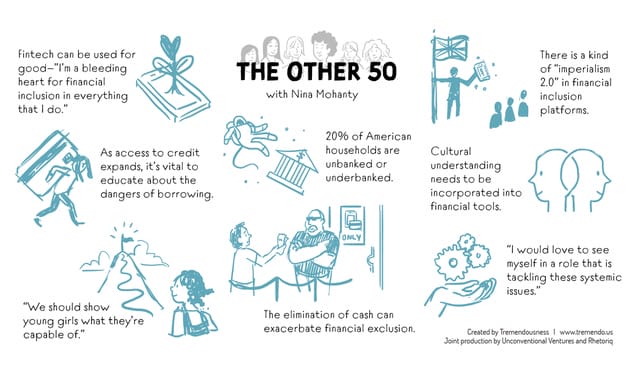
In this week’s podcast episode of The Other 50 (via iTunes and Spotify), Theodora Lau and Bradley Leimer have an engaging and free-ranging talk with Nina Mohanty on personal social responsibility, consumer debt, open banking, FinTech, financial services business model innovation, and financial education and how it impacts us individually. Learn about Nina’s passion about FinTech’s ability to drive broader financial inclusion and financial literacy, and her views on women’s empowerment and the importance of children’s education.
See more by the team here.
More information about Irish Tech News and the Business Showcase
FYI the ROI for you is => Irish Tech News now gets over 1.5 million monthly views, and up to 900k monthly unique visitors, from over 160 countries. We have over 860,000 relevant followers on Twitter on our various accounts & were recently described as Ireland’s leading online tech news site and Ireland’s answer to TechCrunch, so we can offer you a good audience!
Since introducing desktop notifications a short time ago, which notify readers directly in their browser of new articles being published, over 16000 people have now signed up to receive them ensuring they are instantly kept up to date on all our latest content. Desktop notifications offer a unique method of serving content directly to verified readers and bypass the issue of content getting lost in people’s crowded news feeds.
Drop us a line if you want to be featured, guest post, suggest a possible interview, or just let us know what you would like to see more of in our future articles. We’re always open to new and interesting suggestions for informative and different articles. Contact us, by email, twitter or whatever social media works for you and hopefully we can share your story too and reach our global audience.
Irish Tech News
If you would like to have your company featured in the Irish Tech News Business Showcase, get in contact with us at [email protected] or on Twitter: @SimonCocking
More about Irish Tech News
Irish Tech News are Ireland’s No. 1 Online Tech Publication and often Ireland’s No.1 Tech Podcast too.
You can find hundreds of fantastic previous episodes and subscribe using whatever platform you like via our Anchor.fm page here: https://anchor.fm/irish-tech-news
If you’d like to be featured in an upcoming Podcast email us at [email protected] now to discuss.
Irish Tech News have a range of services available to help promote your business. Why not drop us a line at [email protected] now to find out more about how we can help you reach our audience.
You can also find and follow us on Twitter, LinkedIn, Facebook, Instagram, TikTok and Snapchat.