

If you consider the ocean to be an endless source of untouched and undiscovered riches, this is your wake-up call. One in four fish stocks are overfished, according to the United Nations Food and Agriculture Organisation. A recent study found that, by 2030, more than half of the fish species will either have all their stocks collapsed or depleted. Some parts of the world are overexploiting stocks.
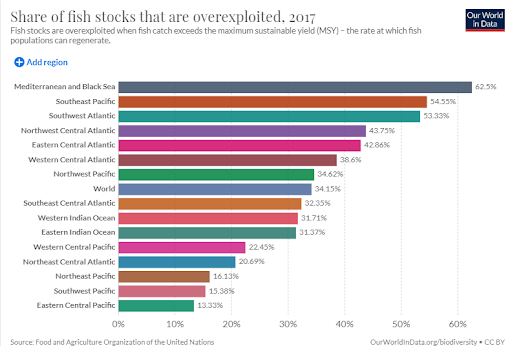 (Image Source: Our World in Data)
Blockchain technology could be the answer to sustainable fishing thanks to digital tags that monitor all aspects of a fish’s life cycle and help fishermen understand what’s happening at sea.
Once tagged, fish will be tracked by GPS and automatically shared with all stakeholders involved in their catching, processing, transportation and sale. And thanks to the Internet of Things (IoT), farmers will be able to monitor and manage their livestock from anywhere in the world via mobile devices.
The implications are huge for the $10 billion global industry, which is currently based on paper-based records or old-fashioned hard copies that require expensive shipping or risky but time-consuming travel between ports.
There are numerous ways that blockchain could help to preserve fish stocks and create a more sustainable industry- he highlights three areas that should be implemented right away.
1) Improving traceability
Current regulation stipulates that fish need to be labelled with a unique catch number, which must be attached to the product at every stage of its journey (transport, processing and sale). The process is burdensome and time-consuming, which results in products being mislabelled or illegally re-classified as cheaper species.
Blockchain would offer an instant, tamper-proof system of recording fish catch data and their point of capture, thereby helping to prevent illegal fishing- a major cause of the decline in fish stocks.
2) Reducing the cost of compliance for suppliers
Blockchain can help ensure that all members in the supply chain are compliant with international sustainability and traceability standards, such as the Worldwide Responsible Accredited Production (WRAP) programme. And it could also provide real-time information on any fish caught in specific regions.

(Image Source: Source Trace)
For example, if a lorry-load of fish is caught in a region that is permitted to export certain species, but there is a quota on the amount that can be taken, blockchain could track the rate at which fish are being removed by ship and halt any individual load that exceeds the limit.
3) Improving consumer confidence
Blockchain can help to make the industry more transparent. A simple QR code on packaging will enable consumers to check where and when their fish was caught, as well as verifying the species and point of origin. Blockchain can also help trace food contamination outbreaks or other health and safety issues back to their source.
Blockchain will also allow the transfer of data and documents in real-time, ensuring that the chain of custody remains continuous- even if one document is lost. The end result will be safer, healthier, and more sustainable fish that costs less and has a shorter travel time between ports.
Ocearch is one company whose aim is to streamline the global supply chain of seafood. When a fish is caught, it will be tracked and tagged using blockchain technology, making fish traceable at every stage. This will help to reduce the economic cost of compliance for all stakeholders involved in this supply chain. It will also improve consumer confidence and allow consumers to find out where their food came from when it was caught by checking out a QR code on each piece of packaging.
Today’s consumers are continually looking to purchase food that has been responsibly made and sourced in a way that has the least amount of harm to the environment, the people involved in the process and animals and plants involved. For this reason, blockchain technology could be the saving grace with its potential to be a real game-changer, enabling compliance which is in line with consumer demands.

(Image Source: Medium)
Not only does it tick all of the boxes mentioned above, on the flip side, it also cuts out unnecessary costs for fish farmers and administration clerks in front the entire supply chain, while moving it from a paper based business into the new world of technology that is packed full of a future of more sustainability, less discrimination and lower costs. If there is one industry that could really benefit from blockchain, it’s fishing (not banking).
How can blockchain help fishing?
By capturing all the information about a fish and recording the details at each stage of its life cycle, blockchain can help fishermen identify what is happening at sea (such as when stocks are low or when there has been a problem), as well as taking action to mitigate any long-term problem.
This would be hugely beneficial to the industry because transparency is fundamental: by providing real-time information on catch, how much was caught, where and when it was caught and which species it is, companies will be able to work more efficiently with their supply chain partners to minimise overfishing. This will eliminate costly losses from mislabelling and illegal fishing.
Blockchain could also be used to help improve traceability and work towards a sustainable future for fish stocks, by enabling fishermen who are currently operating outside the system to become part of the solution.
The factors affecting the future sustainability of fishing
Fishing is a livelihood that many people depend on to get food. The fishing industry has recently found itself at crossroads: the present unsustainable way of fishing and the future sustainable option of fishing.
There are several factors that have an impact on whether or not today’s fisheries survive in the long run including fish populations, environmental changes, human behaviour and technology development. All of these factors must be looked at to make a conclusion on whether or not today’s fisheries can survive in the long run.
Eventually, today’s fisheries will become unsustainable unless human behaviour changes and the environment grows. Factors that contribute are human behaviour change and environmental growth.
Firstly, one factor is that humans are becoming more educated about the environment and resources needed for survival. As people become more educated about their resources, they will incorporate them into daily life. This means that humans will become more educated about the importance of water and marine life.
They will realise how important it is for them to protect these resources and make an effort to do so. As this happens, humans may think twice before they take as much fish from today’s fisheries as they do. Eventually, the overfishing issue may be put to rest if humans educate themselves about the lack of future fish in today’s oceans. The future sustainability of fishing is dependent on people being willing to change their behaviours and work towards environmental sustainability.
 (Image Source: Iberdrola)
Secondly, there are three main factors that contribute to environmental growth: ocean acidification, constructions in marine environments, and changes in weather patterns. All of these factors will have an impact on the future sustainability of fishing and the industry.
If human behaviour continues to change, we will eventually take less fish from today’s fisheries. The ocean acidification factor is also important because as humans continue to take less fish from today’s fisheries, there will be a decrease in marine life.
This means that marine environments might not be able to provide today’s fisheries with the same variety and quantity of fish it currently does. Though these changes are devastating at times, they can improve today’s fisheries if human behaviour continues to change and we work towards environmental sustainability.
Water pollution has many negative effects on the environment including marine life and humans. Water pollution can be caused by many different things such as waste, oil spills and improper disposal of chemicals. These things represent a serious problem for the fish population in today’s fisheries.
Today’s fisheries are already suffering from low fish population and environmental change. If human behaviour continues to be irresponsible, then the future sustainability of fishing is in jeopardy because corporations will not take very good care of today’s fisheries. If human behaviour does not change and water pollution continues to be an issue, then the future sustainability of fishing is in trouble.
Author Bio:
Rebecca Barnatt-Smith is a freelance journalist, specialising in the future of technology, crypto and business. She has been published in a number of publications such as ReadWrite, Huff Post and Hackernoon and loves talking about all things immersive tech and modern-day blockchain developments.
Prepared by Ebony Ximines-Parke
More about Irish Tech News
Irish Tech News are Ireland’s No. 1 Online Tech Publication and often Ireland’s No.1 Tech Podcast too.
You can find hundreds of fantastic previous episodes and subscribe using whatever platform you like via our Anchor.fm page here: https://anchor.fm/irish-tech-news
If you’d like to be featured in an upcoming Podcast email us at [email protected] now to discuss.
Irish Tech News have a range of services available to help promote your business. Why not drop us a line at [email protected] now to find out more about how we can help you reach our audience.
You can also find and follow us on Twitter, LinkedIn, Facebook, Instagram, TikTok and Snapchat.